Do Solar Pool Heaters Work on Cloudy Days?
If you’re considering a solar pool heating system, one of the first questions you probably have is:
“What happens when it’s cloudy?”
It’s a fair question. Many homeowners assume solar pool heating only works in perfect, bright sunshine. In reality, modern solar pool heating systems can still collect useful heat during partly cloudy conditions — and in most climates, they provide substantial season-long heating performance even when the weather isn’t perfect every day.
Here’s how it actually works.
Yes — Solar Pool Heaters Still Work on Cloudy Days
Solar pool heaters do not stop working the moment clouds appear.
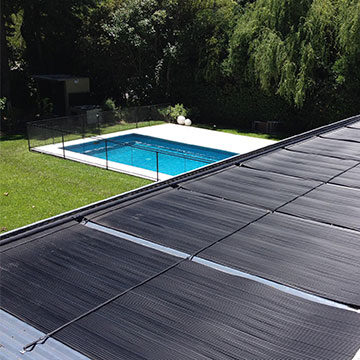
Even on cloudy days, ultraviolet and infrared solar radiation still reaches your roof. Unglazed solar pool collectors absorb that available heat and transfer it into your pool water.
Performance is reduced compared to a full-sun day, but the system continues producing heat whenever the collectors are warmer than the pool water.
Think of it this way:
- Bright sunny day: Maximum heating performance
- Partly cloudy day: Moderate heating performance
- Overcast/rainy day: Minimal heating performance
Your pool also acts as a large thermal battery, storing heat accumulated over previous sunny days.
How Solar Pool Heating Actually Works
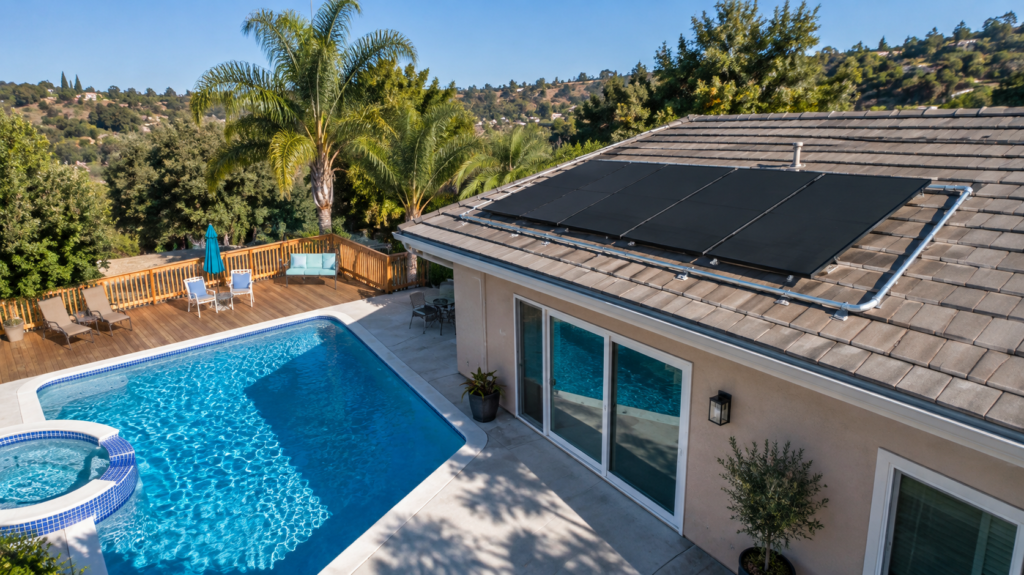
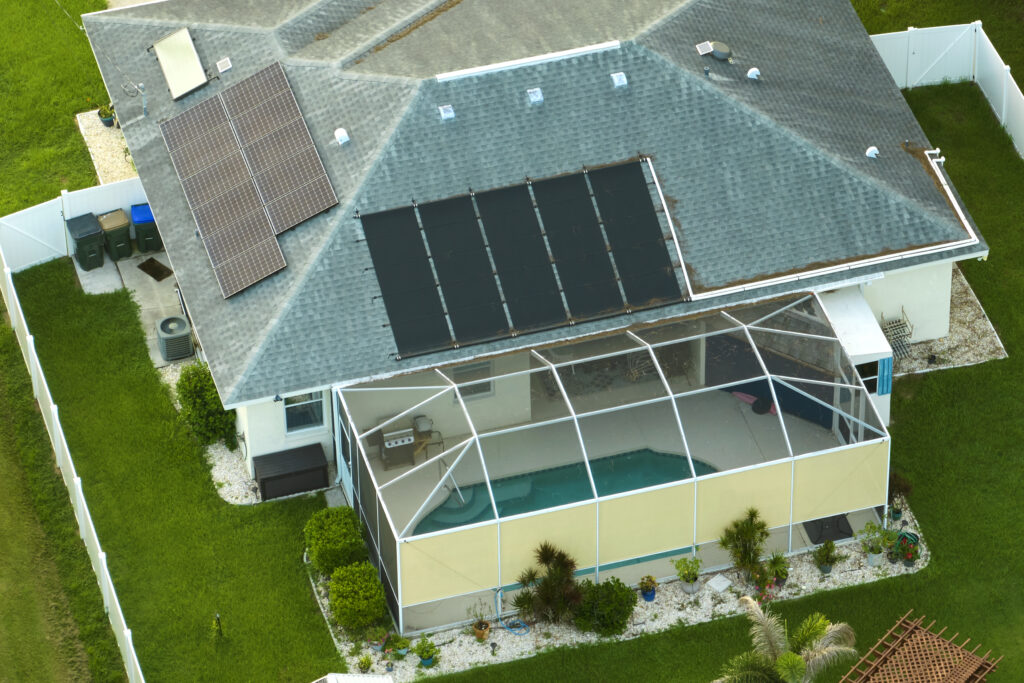
A solar pool heating system uses your existing pool pump to circulate water through solar collectors installed on a roof or rack.
The process is simple:
- Pool water is pumped through the solar collectors
- Sunlight warms the collectors
- Heat transfers into the water
- Warm water returns to the pool
When the sun is available — even partially — the system harvests free heat.
Most modern systems also use an automatic solar controller that compares:
- Roof temperature
- Pool water temperature
The controller only sends water to the roof when useful heat is available.
Do Solar Pool Heaters Work Better in Certain Climates?
Absolutely.
Solar pool heating performs best in:
- Florida
- Arizona
- Southern California
- Texas
- Nevada
- Hawaii
But systems are also highly effective in:
- North Carolina
- South Carolina
- Georgia
- New Jersey
- Virginia
- Tennessee
In many northern climates, solar pool heating can significantly extend the swim season from spring through fall.
What Matters More Than Cloudy Days
Many homeowners focus too much on occasional cloudy weather and not enough on the factors that actually determine performance.
The biggest factors are:
1. Collector Area
The larger the solar collector area relative to your pool surface area, the greater the heating capability.
2. Pool Surface Coverage
Using a solar blanket or automatic pool cover dramatically reduces nighttime heat loss.
3. Roof Orientation
South-facing roofs are ideal, but east and west-facing roofs often work very well too.
4. Wind Exposure
Wind increases evaporative heat loss from the pool surface.
5. Desired Swim Season
Heating a pool in July is much easier than trying to maintain summer temperatures in late fall.
How Warm Can Solar Pool Heating Keep a Pool?
In many climates, a properly sized solar pool heating system can maintain:
- Mid-80s water temperatures during swim season
- Comfortable swimming temperatures for several additional months per year
- Earlier spring openings and later fall closings
In warmer climates like Florida or Southern California, many pool owners swim nearly year-round with solar.
What Happens During Several Cloudy Days in a Row?
If several heavily overcast days occur consecutively, pool temperature may gradually decline.
However:
- Pools lose heat relatively slowly
- Sunny days quickly recover lost temperature
- Properly sized systems are designed around average weather patterns, not perfect conditions every day
This is why professional system sizing is critical.
Solar Pool Heating vs. Gas and Heat Pumps
Cloudy weather affects all heating systems differently:
| Heating Type | Effect of Cloudy Weather | Operating Cost |
|---|---|---|
| Solar Pool Heating | Reduced output | Extremely low |
| Heat Pump | Reduced efficiency in cool weather | Moderate |
| Gas Heater | Unaffected | High |
Many homeowners choose solar because:
- Operating costs are extremely low
- Systems are reliable
- Maintenance is minimal
- Payback periods are often attractive
- Swim season extension is substantial
The Bottom Line
Yes, solar pool heaters absolutely do work on cloudy days.
While peak performance occurs during full sun, solar pool heating systems are designed around real-world weather conditions, not perfect laboratory conditions.
For many pool owners, solar heating provides:
- Longer swim seasons
- More comfortable water temperatures
- Lower heating costs
- Greater pool enjoyment
The key is proper system sizing and installation.
If you want to know how much solar pool heating could extend your swim season, the best next step is a professional sizing and performance analysis based on your:
- Location
- Pool size
- Roof space
- Desired swim season
- Existing heating system
A properly designed system can often deliver decades of low-cost pool heating using nothing more than sunlight.